PASSING THROUGH
  • Home
  • Blog
  • Interests & themes
    • Paid work
    • Feral Christians
    • East End Christianity
    • Peter Zapffe
  • Contact

This is the night (Easter Eve, Holy Saturday)

4/4/2026

0 Comments

 
O truly blessed night, when things of heaven are wed to those of earth and divine to the human.
​

The Exsultet (also known as the Easter Proclamation) is a solemn, sung hymn of praise delivered at the beginning of the Easter Vigil. It acts as a momentus announcement of the Resurrection of Jesus, proclaiming the victory of light over darkness. Usually sung by a deacon (or priest/cantor) near the Paschal Candle after the procession into the darkened church, surrounded by  the faithful holding lit candles. The hymn joyfully invites heaven, angels, and the earth to rejoice, while also recounting salvation history—including the Exodus—and blessing the Paschal Candle as a symbol of Christ. It is an ancient text with roots in the 4th or 5th centuries. It takes its name from its first word, Exsultet (Latin for "Let [them] exult" or "Rejoice"). 
0 Comments

Mr Muggeridge's Miracle

19/1/2026

0 Comments

 
Picture
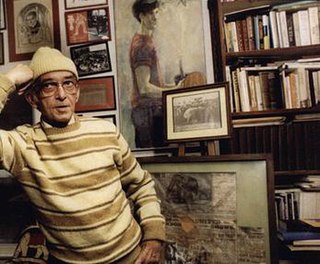
Readers of a certain age may remember British pundit, journalist and moralist Malcolm Muggeridge (1903-1990). He was a famous, later-in life convert to Christianity, and a supporter of the self-appointed keeper of the nations morals, Mary Whitehouse and of her pernicious Nationwide Festival of Light. Despite all that, I rather liked Muggeridge, or St Mugg as he was mockingly called.

Mr Muggeridge developed an admiration for Mother Teresa of Calcutta (since sainted), and trekked off with a film crew in tow to her Calcutta House of the Dying. In one of his books he recounted an 'incontrovertible miracle' that occurred whilst filming. A scene was to be shot inside the dark building where the Sisters brought in the dying. The space was so dark that the cameraman, Ken MacMillan, warned that the footage would be unusable. They had not brought portable lighting to the hospice. “Film it anyway,” said Muggeridge.

Back at the BBC, when they developed the film, a surprising thing happened: the scene was perfectly lit. St Mugg pronounced it a miracle. 

Except there is more to this miracle than meets the eye. The cameraman had forgotten that the BBC was trialling a new Kodak film stock, a feature of which was far greater sensitivity in low light conditions. 

While Muggeridge was certain this was a divine, miraculous light emanating from Mother Teresa herself, cameraman Ken MacMillan realised it was due to the new advanced film stock. 

This did not deter St Mugg, who continued to promote the Albanian Nun and the miracle of the divinely-illuminated image filmed in near pitch-black circumstances. (Readers may recall that Mother Teresa had her critics, not least among them Christopher Hitchens).

And the moral here? There may be occasional miracles to be witnessed but they are both rarer and more subtle (like the miracle of human love and friendship, duty and care). In the case of dramatic miracles, one should first exhaust all possible 'ordinary' explanations.

Hell's Angel: Mother Teresa. A film by Christopher Hitchens - YouTube here

0 Comments

Are you one of those who have multiple open tabs in your browser?

5/1/2026

0 Comments

 
Below, a pre-internet facility for having seven books open at once.
Picture
0 Comments

I might give up opinions for 2026

31/12/2025

0 Comments

 
Picture
31 December 2025: The end of the first quarter of this century. My mind, despite its best endeavours, drifts toward New Year resolutions. This was first to come to mind: I’m wondering, seriously, if I might give up opinions for new year. They are the source of so much bother. But how to achieve that, realistically? Conscious effort seems the only option in the short term, perhaps leading to a change in disposition. Or a first step may be to stick with opinions but not to express them. That may be more achievable in the short term. (I am reminded of the advice that before saying anything one might ask ‘does this need to be said? Does it need to be said now? Does it need to be said by me?).

0 Comments

Christmas. The Incarnation

21/12/2025

0 Comments

 
Over decades, as priest, preacher and human journeyman, I did my best to un-inoculate others about Christmas. I wanted us to discard all the cultural and sentimental colouration that obscure its meaning. I largely failed. I wasn't skilled enough. As I see it, the Incarnation was, remains, an apocalyptic event. It contradicts and disrupts the "powers and principalities" of the world.

William Stringfellow described the Incarnation as the "ultimate act of God’s invasion into history". The birth of Jesus was not a peaceful addition to human history but a decisive confrontation where God "invades" a world dominated by the power of death. 'Death' here being not just our final demise but the multitudinous ways in which our humanity is daily deconstructed by our aggression, lovelessness, exploitation, institutions (including the family), politics, economies and systems.
0 Comments

Why Beauty Matters/BBC/Roger Scruton

12/10/2025

0 Comments


0 Comments

Some good things to do and be

28/9/2025

0 Comments

 
Good things:
  1. Self-renunciation: a focus beyond oneself.
  2. The practice (habit) of prayer (broadly defined).
  3. The practice of attention (cf Simone Weil): listening, observing, attending to.
  4. To be a trustworthy person: avoid gossip, never bear false witness, let others speak for themselves (and help them in this), to keep others’ secrets, when entrusted with them.
  5. Economy of speech; chose words thoughtfully, be not a prattler, or verbose, long winded &c.
0 Comments

What L P Hartley should have said

22/9/2025

0 Comments

 
What L P Hartley should have said: “The present is a foreign country. They do things differently here”. I have felt like this most of my adult life, being of an (outgoing) introverted, ironical bent. But it seems ever truer. The idiocy, self-aggrandisement, madness of the age is there to be seen in all its silliness, now amplified by the internet and social media. The good news is that I am far less distressed or distracted by it than before. The result of an interior detachment that also gets stronger, and which feels good. Another take on Nicólas Gómez Dávila’s “When nothing in society deserves respect, we should fashion for ourselves in solitude new silent loyalties.”
0 Comments

Queenie Gibbs, My Best Mate

16/9/2025

0 Comments

 
S and I to Swanage on the Dorset Coast for a few days. The pier allows people to attach remembrances to the deck planks. Thousands upon thousands of them. Some trite, some funny, some moving, all significant to someone or other. This one caught my eye. I've always felt well-disposed to anyone called Queenie, and I am temperamentally drawn to brevity and understatement. One really imagines that they were best mates.
Picture
Also spotted in Swanage. A town on a mission. The Friends of religion and good order are best given a wide berth. They like to make trouble for other folk.
Picture
0 Comments

William McCrossan ("Liturgical William, of Bow")

1/9/2025

0 Comments

 
Picture
William McCrossan (aka Liturgical William of Bow)
"There is a deep instability which should be the mark of the authentic Christian: for here we have no continuing city, but we seek one to come. Apart from other considerations, the acceptance of Baptism is the sign of a profound instability because Baptism is a death unto sin, and a new birth unto righteousness and it requires a renunciation of the vain pomp and glory of the world, with all covetous desires of the same." Unpublished autobiographical essays.
Find out more about Liturgical William of Bow

0 Comments

St James's Church Piccadilly: 'A barbarous brick-cased and ill-shaped pile'

13/7/2025

0 Comments

 
A sermon I preached on the 324th anniversary of the consecration of the London church I served for twenty-eight years (1992-2020) whilst concurrently following the model of the priest-workers by holding secular jobs. St James' has a remarkable history spanning class-ridden conformity and adventurous, on-the-margins, Christian life. Click the 'Read more' button.


Read More
0 Comments

Faithful wincing

25/4/2025

0 Comments

 
To the Blood Donor Centre, Margaret Street, W1. There, looked after by the delightful Livingston. He winced as he gave me the finger-prick test and said he did not like causing people pain. I asked why he had chosen this work. He’d got into it because his mother had died for want of a blood transfusion.

0 Comments

The domestication of Christianity

23/3/2025

0 Comments

 
Miguel de Unamuno, Spanish educator and philosopher (1864-1936):
“Those who believe that they believe in God, but without passion in their hearts, without anguish in mind, without uncertainty, without doubt, without an element of despair even in their consolation, believe only in the God idea, not God Himself.”
It is apparent to me that many people who regard themselves as Christian, and many of whom attend churches, believe that Christianity = niceness, and that being nice is more important than being truthful. Similarly, that one's faith should be steady, inoffensive and always and only a comfort. These are odd readings of the Gospel, and  to varying degrees, a betrayal of it.
0 Comments

Victoria Wood and the humour of ordinary life

10/3/2025

0 Comments

 
I always regarded Victoria Wood's work as brilliantly funny, but I now see that its primary function (in my eyes) is to spread joy. She was a northerner, born in Lancashire. There is something about 'northern' humour - more widely northern personalities and perceptions - that speaks my language. I suppose the technical name for her approach is 'observational humour'.  Her's was always kind, perceptive and affirming of our (often quirky and conflicted) human nature. Here is a compilation of her series Dinnerladies. Such marvellous dialogue, timing and portraits of the kind of people I grew up with.
Victoria Wood: comedian, actress, lyricist, singer-songwriter, composer, pianist, screenwriter, presenter, producer, director, impressionist and entertainer. More importantly, she was a good human being.
0 Comments

"The spiritual suicide of ordination"

7/3/2025

0 Comments

 
Maggie Ross from an interview in the Church Times: "Contemporary theological education prepares people either for the petty battlegrounds of academia or for the spiritual suicide of ordination. Evagrius's notion of the absolute relationship of theology and praxis has been lost. There are a few good people who are exceptional in this regard, but they wisely camouflage themselves. There is an absolute abyss between the clericus and ordinary people, who are implicitly denigrated by them, and most theological education just widens this abyss. Also, so-called spiritual direction as it is practised today is destructive. It is both para-clerical and counter-productive, because it makes people more self-conscious instead of more self-forgetful, which is an important sign of spiritual maturity. Helping another is a charism of the moment, usually inadvertent, and can't be taught."

Maggie Ross is the pen name of a vowed Anglican solitary under episcopal guardianship. I have enjoyed reading her various works, not least because in part they confirm some of my own conclusions, and because they can be a heck of a provocation. Not for her the equation between the Church of England and niceness.

If you find this quotation interesting, here are links to more about her:
  • Silent Ways of Knowing
  • Interview - Silent Witness
  • Freefalling in the love of God
0 Comments

Love’s austere and lonely offices

12/2/2025

0 Comments

 
Recently discovered, this poem by Robert Hayden.

Those Winter Sundays

Sundays too my father got up early
and put his clothes on in the blueblack cold,
then with cracked hands that ached
from labor in the weekday weather made
banked fires blaze. No one ever thanked him.

I’d wake and hear the cold splintering, breaking.
When the rooms were warm, he’d call,
and slowly I would rise and dress,
fearing the chronic angers of that house,

Speaking indifferently to him,
who had driven out the cold
and polished my good shoes as well.
What did I know, what did I know
of love’s austere and lonely offices?

It speaks of the sacrifices many parents make, showing children love in ways they cannot at that stage appreciate, but may come to later. This poem sketches the father's (then unappreciated) work: many mothers do the same, maybe more so. Robert Hayden was American (1913-1980). This poem is dated 1962. "The poem is about the father/son relationship – recalling the poet's memories of his father, realizing that despite the distance between them there was a kind of love, real and intangible, shown by the father's efforts to improve his son's life, rather than by gifts or demonstrative affection. The author's words suggest that the son feels remorse that he failed to recognise this in his father's lifetime." (Wiki). The 'father' here was in fact Hayden's foster father.

I like the use of 'offices' ("What did I know, what did I know / of love’s austere and lonely offices?"). Clergy are canonically required to 'say the Offices' of Morning and Evening Prayer. Many don't. In the Olden Days you'd need to have the Office book, a bible and other material to see what 'extras' were needed on that particular day. Now, it is all there on your tablet or phone. Convenient Offices, you might say. But there's nothing convenient about sacrificial love. That's its point and its value.

0 Comments

Monsignor Quixote (1987) and friendship

4/2/2025

0 Comments

 
Graham Greene's book is the last of his religious novels. It concerns the priest of the the village El Toboso who claims to be a descendant of Don Quixote. An encounter with a mysterious bishop leads to Father Quixote being honoured by the rank of Monsignor - to the annoyance of his own bishop. This 1987 film stars Alec Guiness as Father Quixote and Leo McKern as village communist mayor Sancho Zancas. It presents various themes, but the key theme to my mind is that of friendship: Quixote's friendship with the (ex) Mayor, and his friendship with God. The character is gloriously imperfect yet embodies such a wonderful approach to the Christian adventure.
0 Comments

Candlemas: "I have enough". Bach does it again.

2/2/2025

1 Comment

 
2 FEBRUARY 2025  At home, alone, on a frosty and vibrantly sunny morning, I celebrate Candlemas, aka The Presentation (of Christ in the Temple). See Luke, 2:22-40. A ‘principal feast’ in the Church of England.

Mary and Joseph present Jesus at the Temple, as required in the Torah. On arrival they encounter the aged Simeon. According to the gospel, he had been promised that "he should not see death before he had seen the Lord's Christ" (Luke 2:26). Simeon then uttered the prayer that would become known as the Nunc Dimittis, or Canticle of Simeon, which prophesied the redemption of the world by Jesus:

"Lord, now let your servant depart in peace, according to your word; for my eyes have seen your salvation which you have prepared in the presence of all peoples, a light for revelation to the Gentiles, and for glory to your people Israel". (Luke 2:29–32).
 
Bach wrote his Cantata “Ich habe genug” (BWV 82) to celebrate the feast in February 1727. I first encountered it 30+ years ago, as part of my unfocussed grazing of the Bach Cantatas. It is written for bass, is (IMO) hauntingly beautiful and with just a hint of the melancholy I regard as evidence (in any art form or person) of having understood something important about life’s adventure.
 
Simeon has seen the promised child and has held in his arms this infant who is the incarnation of all hope. It has given him all he needs or wants. The encounter leaves the old man perfectly ready to die. “It is enough” (“Ich habe genug”).
 
You could say that the work is about making a proper accomodation with the prospect of one's death. The encounter fills Simeon with such gratitude, hope, and joy that he is ready for this, when it comes. What a marvellous disposition just prior to The Great Liberation.
 
Below, German baritone Christian Gerhaher with members of the Bavarian Radio Symphony Orchestra

1 Comment

'Stop' says this take on the Last Supper: 'take me in....'

4/1/2025

0 Comments

 
I am poor company in art galleries. I much prefer powering through alone and stopping only when a canvas arrests me. I have previously written about the effect encountering The Subway (1950) by George Tooker had on me in New York. I had a similar experience  on seeing this painting of The Last Supper in Bruges.
Picture
The artist is Gustave Van de Woestijne (1881–1947), a Belgian expressionist painter. He entered the Benedictine order in Leuven in 1905, but quickly sensed that monastic life was not for him and left after four weeks. Maybe their pre-admission preparation was not up to the mark.

He remained a Christian. An expression of this is seen in this monumental portrayal of the Last Supper. And through it he expresses a criticism of convential artistic piety: "Away with this saccharine, stultifying, strait-laced religious art! We’ve had enough of it, and our Catholic Church is already crammed full of all kinds of such bland stuff. […] I am neither edified nor affected when I enter our churches and look at the modern ornaments, statues or paintings, on the contrary, I have the urge to curse".

His style was considered blasphemous by some. An encouraging sign. Fortunately, he found support from the van Buurens, Brussels art collectors who bought many of his works and, in 1927, sponsored a trip to Florence that allowed him to study fresco art. This canvas reflects his interest in fresco painting and his quest for modern religious art.

Why does it strike me so?

For a start, it is not mannered or pretty. No halos or pious expressions. No looking up, heavenwards. The proportions of the canvas (taller than it is wide) requires that the disciples huddle close. Something important is happening - draw near.

There is no iconography, just the essentials: wine and a loaf of bread. And the bread is an ordinary loaf, no delicate host. It belongs in the ordinary transaction of heavenly realities. The apostles depicted here  could be miners or labourers or fishermen. Hairstyles are those of the 1920s, pitch black, neatly combed. There is a sad solemnity in their grave faces. Jesus’ passion happens every day again.

Jesus’ hair and beard are red, along with the wine and along with the hair of the figure on the lower left. Judas, maybe? Jesus looks towards him. 

Van De Woestijne's picture has no extras, only the essentials - table, people, bread, wine - needed to depict the Last Supper.  These betoken solidarity (God with us), tragedy, longing, love. The building bricks of our human adventure.
0 Comments

Free new trick

1/1/2025

0 Comments

 
Picture
The practice of gratitude may be one of the best ‘enhancers’ we can find.  I know it runs two risks in the way such a claim is perceived: one is that it is ‘religious’; the other that it belongs to a middle-aged or elderly view of things.  It may well be that the best insights of our various religions have come to see its value as an orientation and attitude; and ditto with the wise-older amongst us. So what?

If I want everything then what I do possess will always show a deficit against that target; if I see all as gift (life, senses, other people, what possessions I have, and the fact of the universe, this planet, its without-which-we-would-not-be here Sun) then the formula behind the equation becomes a positive, a credit.

When all things are viewed from this perspective, gratitude seems to spring up and change how we experience things.  Certain ‘I wants’ transform into ‘I haves’, though the condition this brings about (it seems to me) is better described as ‘we haves’, since the all-dominant I appears, too, to undergo some welcome change in this marvellous alchemy.

0 Comments

Lead us not...

9/10/2024

0 Comments

 
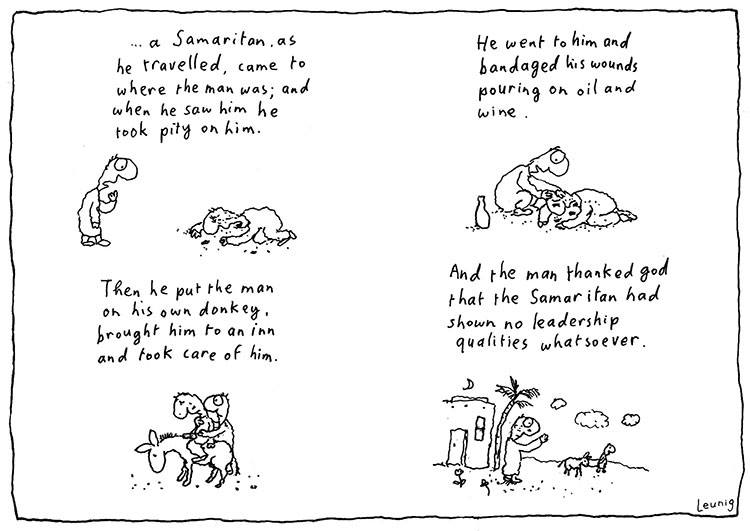
Have you noticed how, in recent years, an obsession with 'leadership' and 'leaders' has crept into much discourse (and fantasy) about business, the third sector, the public sector and even the churches? It's a great bore. Organisations need competent managers at every level, and those in such roles will, inevitably and necessarily, influence, shape and 'lead' developments in those organisations. But what seems to have happened is that this essential function and aspect has now become personalised into 'a leader'.  This is ego-talk. Many find it irresistible.

In the church (I am mostly familiar with the Church of England) the 'leadership' fetish has grown apace. A small example is the growing number of church websites that now list the clergy as 'the leadership team' - and I have seen some that locate them in 'the senior leadership team'. Frankly, it's all so desperate. What should be fellowship often seems now to be follower-ship.

To have leaders, you need the led. There is a place for this where it is operationally and functionally necessary for tightly defined outcomes (think uniformed services and organisations with precise functions and outcomes). But in Christian communities it can only produce drone-disciples who surrender responsibility for their own Christian life to the 'experts', the leaders. And don't think that the ghastly cliché about 'servant-leader' avoids the pitfalls and dangers.

I recently attended a mandatory safeguarding course, attended mostly by clergy and with some churchwardens. The (very competent) facilitator had, as part of her input, referred to the role that power and power-imbalances play in church abuse, and had illustrated this by some high-profile cases. As the event progressed, I was struck by how often 'leader' and 'leadership' were used by participants - in a sometimes slightly self-aggrandising way ("As the leader of my parish..."). I pointed this out, this link with what we had been told and how the conversation was going. There was some agreement, but others thought the two things were quite separate.

Mainline church denominations 'embody' power relations and differentials in various ways, some subtle. Priests and bishops over laity, for example. Church architecture is another (the sacred sanctuary and altar, with the laity in their theatre-like pews). And another is found in who may speak and who is required to 'reply' following a set script. These are aspects of liturgical exchanges and liturgical life.

I set these matters out bluntly to illustrate dimensions we often don't see clearly. There are many clergy who operate within these structures with attentiveness, humanity and sensitivity, and who mitigate the more dangerous aspects of the leadership fetish. They focus, first, on being disciples. But there are some clergy who don't. And there are laity who like to be 'led'. That does not make for mature Christian explorers.
Picture
0 Comments

"You're not pregnant"

9/9/2024

0 Comments

 
I had been summoned by algorithm to a screening in older men for abdominal aortic aneurysm. It meant a trip to the Old Kent Road Surgery, a dreary place with a crowded, pinched waiting room and mirrored wall plates – why I wonder: the sick generally don’t wish to see themselves. The nurse doing the screening was cheerful and human. She announced, after applying gel and the ultrasound scanner to my abdomen, that ‘it looks perfect…. and you are not pregnant’. Such encounters make the day.

0 Comments

Meaning and message(s)

25/8/2024

0 Comments

 
Picture
Seen in the West End yesterday: a stylish man sporting a sharp haircut and expensive-looking clothes. A tattoo on the rear of his left upper arm, so not visible to him (as an aide-memoire, say) but to those following. In a rather well-chosen typeface too. 

It read: "Attached to Nothing, Connected to Everything".

I didn't dare interupt him to ask about this. I imagine he is announcing his commitment to non-attachment and interconnectedness. I can only respect all that. But his collection of designer-labelled shopping bags seemed to confuse the message.


0 Comments

Kitch and sentimentality

1/7/2024

0 Comments

 
Visitors to these pages (that may only be me) will have spotted various posts that excoriate sentimentality. It is a fake and devaluing response to the challenges of life. It is rife.  And so I was glad to come across this in Roger Scruton's 'Confessions of a Heretic':
The Czech novelist Milan Kundera made a famous observation. 'Kitsch,' he wrote, 'causes two tears to flow in quick succession. The first tear says: How nice to see children running on the grass! The second tear says: how nice to be moved, together with all mankind, by children running on the grass!' Kitsch, in other words, is not about the thing observed but about the observer. It does not invite you to feel moved by the doll you are dressing so tenderly, but by yourself dressing the doll. All sentimentality is like this: it redirects emotion from the object to the subject, so as to create a fantasy of emotion without the real cost of feeling it. The kitsch object encourages you to think, 'look at me feeling this; how nice I am and how lovable'. That is why Oscar Wilde, referring to one of Dickens's most sickly death-scenes, said that 'a man must have a heart of stone not to laugh at the death of Little Nell'.
0 Comments

HM's motto for Number 10

25/6/2024

0 Comments

 
Picture
Harold Macmillan, 1st Earl of Stockton, (1894–1986) British statesman and Conservative politician who was Prime Minister of the United Kingdom from 1957 to 1963. He was nicknamed "Supermac" and was known for his pragmatism, wit, and unflappability. Here is his motto when at Number 10.

Motto for Private Office and Cabinet Room: "Quiet, calm deliberation disentangles every knot - HM"

0 Comments
<<Previous

    Categories

    All
    Art
    Church As Institution
    Dogs
    Feasts And Festivals
    Film
    Humour
    Language
    Liturgy
    Misc
    Music
    Observed
    People
    Places
    Power
    Prayer
    Quotations
    Sentimentality
    Sermons
    Signs & Wonders
    Vocation

    Archives

    April 2026
    January 2026
    December 2025
    October 2025
    September 2025
    July 2025
    April 2025
    March 2025
    February 2025
    January 2025
    October 2024
    September 2024
    August 2024
    July 2024
    June 2024
    April 2024
    February 2024
    January 2024
    December 2023
    November 2023
    July 2023
    May 2023
    April 2023
    March 2023
    December 2022
    November 2022
    October 2022
    September 2022
    July 2022
    February 2022
    December 2021
    October 2021
    September 2021
    August 2021
    April 2021
    February 2021
    January 2021
    December 2020
    August 2020
    July 2020
    May 2020
    February 2020
    December 2019
    November 2019
    July 2019
    May 2019
    April 2019
    March 2019
    February 2019
    January 2019
    November 2018
    October 2018
    September 2018
    August 2018
    July 2018
    June 2018
    February 2018
    January 2018
    November 2017
    September 2017
    August 2017
    June 2017
    May 2017
    March 2017
    January 2017
    November 2016
    September 2016
    August 2016
    June 2016
    May 2016
    March 2016
    February 2016
    January 2016
    December 2015
    November 2015
    October 2015
    September 2015
    July 2015
    June 2015
    May 2015
    April 2015
    February 2015
    January 2015
    November 2014
    September 2014
    August 2014

    Sites I keep an eye on
    Beaker Folk
    A Contemporary Spirituality
    Mother Pelican

    Feral Spirituality
    The worker priest


Belief is reassuring. People who live in the world of belief feel safe. On the contrary, faith is forever placing us on the razor's edge. Jacques Ellul
No one is useless in this world who lightens the burden of it for any one else. Charles Dickens (Our Mutual Friend)
Get in touch
(c) Hugh Valentine